

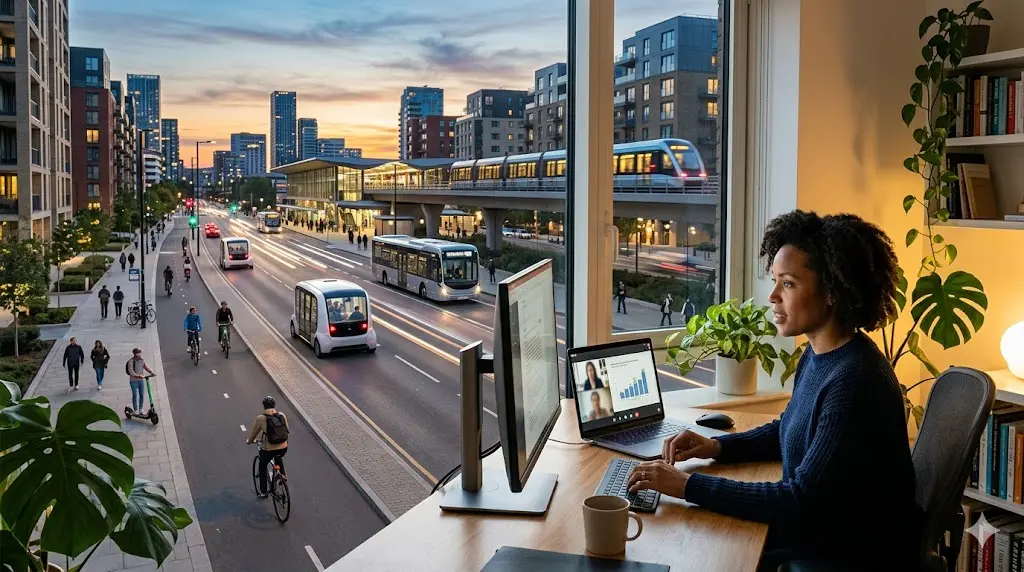
Remote work is quietly reshaping how people move, commute, and plan their daily travel in ways most people don’t fully notice yet. When you look closely at why remote work is influencing future transportation trends, you start seeing fewer predictable rush hours, changing fuel demand patterns, and even a shift in how cities design mobility systems. It’s not just about working from home—it’s about how that freedom rewires movement itself.
Here’s the thing: transportation systems were built around the idea that everyone moves at the same time to the same places. Remote work breaks that assumption completely.
Remote work is reducing traditional commuting, changing peak travel demand, and pushing cities toward flexible transportation systems. It influences how people use public transit, ride-sharing, and personal vehicles. The biggest shift is that travel is becoming optional, distributed, and far less tied to strict schedules.
What Is Remote Work and Its Influence on Transportation Trends?
Remote work refers to professional work performed outside traditional office spaces, usually from home or flexible locations. When this becomes widespread, it directly changes how often and why people travel.
Transportation systems historically depend on fixed routines—morning commutes, evening returns, and predictable congestion patterns. Remote work disrupts that entire structure.
Remote Work Mobility Shift: The change in travel behavior and transportation demand caused by employees no longer needing to commute daily to centralized workplaces.
What most people overlook is that remote work doesn’t just reduce travel. It changes when and how travel happens. Instead of daily commuting, people now travel in bursts—occasional office visits, flexible errands, and lifestyle-based movement.
In my experience observing commuting behavior changes, the biggest shock wasn’t reduced traffic. It was how unpredictable travel patterns became almost overnight.
Why Remote Work Matters for Transportation in 2026
By 2026, transportation planning is no longer based on fixed commuter volumes. It’s based on fluctuating, hybrid mobility behavior.
Cities that once relied on rush hour density are now dealing with spread-out movement throughout the day. That might sound like a small change, but it affects everything from bus schedules to fuel consumption patterns.
Here’s a counterintuitive insight: fewer commuters doesn’t always mean less congestion. In some areas, traffic spreads out across the day instead of disappearing, creating a “flat congestion curve” rather than peak-hour spikes.
Another major shift is cost restructuring. Public transportation systems that depended on daily commuters are now adjusting routes and pricing models. Some routes see lower demand, while others—especially leisure and mid-day travel—are increasing.
I’ve seen cases where cities underestimated how much mid-week travel would rise once remote work became common. People aren’t staying home more; they’re just traveling differently.
Global labor mobility reports from institutions show how flexible work models are influencing commuting patterns across both developed and emerging economies.
How Remote Work Is Reshaping Transportation Systems Step by Step
Understanding this shift becomes clearer when broken into behavioral stages that reflect real-world movement changes.
The first stage is commute elimination. Workers no longer travel daily to centralized offices, which immediately reduces predictable morning and evening traffic peaks.
The second stage is travel redistribution. Instead of fixed commuting, people travel for specific purposes like meetings, coworking visits, or social activities.
The third stage is micro-mobility adoption. Short-distance travel becomes more important than long structured commutes. People rely more on flexible transport options like ride-sharing and bicycles.
The fourth stage is hybrid commuting. Some employees return to offices only a few days a week, creating irregular traffic patterns that transportation systems struggle to forecast.
The fifth stage is lifestyle-based mobility. Travel becomes tied to personal routines rather than work schedules. People move when it suits their lifestyle, not when offices demand it.
Why traditional commuting models no longer predict behavior accurately
Let me be direct here. Most transportation models still assume predictable human movement patterns. Remote work breaks that assumption completely. People don’t move less—they move differently, and that difference is what most planners underestimate.
Expert Tip
Transportation planning based only on average daily commuters often fails in remote work economies. Systems that incorporate flexible demand forecasting tend to perform better because they reflect real human variability rather than fixed schedules.
Expert Insights: What Actually Works in the New Mobility Era
One thing I’ve noticed is that transportation demand is becoming more “event-driven” than schedule-driven. Instead of rush hours, cities now experience movement spikes tied to events, weather, or social activity patterns.
Here’s a personal observation that might sound a bit blunt. Many transportation systems still behave like everyone works 9 to 5, even when a large part of the population doesn’t. That mismatch creates inefficiencies that are surprisingly expensive.
Another insight is that remote workers often choose location flexibility over commute time savings. Instead of traveling daily, they may travel longer distances occasionally for better lifestyle experiences.
What most guides miss is emotional geography. People don’t just travel for work anymore—they travel for mood, comfort, and social connection. That changes transportation demand in subtle but powerful ways.
Ride-sharing patterns also reflect this shift. Instead of predictable morning usage spikes, there’s now steady usage throughout the day, especially in suburban areas.
Expert Tip
Transportation providers that optimize for “all-day demand consistency” rather than peak-hour efficiency tend to adapt better to remote work environments.
Real-World Examples of Remote Work Changing Transportation
Let’s take a realistic scenario.
In a mid-sized city with a large office district, commuter traffic used to peak sharply at 8–10 AM. After remote work adoption, those peaks flattened significantly. However, mid-afternoon travel increased because people started running errands, attending flexible meetings, or visiting coworking spaces.
Another example involves a suburban region where residents previously commuted long distances daily. After remote work became common, weekly commuting dropped, but weekend travel increased because people used saved time for leisure trips.
Here’s something interesting: transportation companies initially expected demand to drop overall. Instead, demand shifted in shape rather than volume. That shift caught many planners off guard.
In my experience, the biggest misunderstanding was assuming “less commuting equals less transport need.” That’s only partially true. The reality is more dynamic.
What Most People Miss About Remote Work and Transportation
One overlooked factor is psychological freedom. When people no longer have to travel, they become more selective about when they do.
Another issue is infrastructure lag. Roads, transit systems, and scheduling models were designed for a world where commuting was mandatory. Adjusting them takes time, and in many regions, that adjustment is still incomplete.
Here’s a counterintuitive point: remote work can sometimes increase long-distance travel. People save time during the week and then use it for occasional travel experiences, which can increase demand for intercity transport.
That’s not something most early forecasts predicted.
People Most Asked About Remote Work and Transportation Trends
How does remote work affect daily commuting?
It reduces regular commuting frequency and replaces it with occasional or flexible travel based on need rather than fixed schedules.
Does remote work reduce traffic congestion?
In many cases, yes during peak hours, but congestion often spreads throughout the day instead of disappearing completely.
How are public transport systems adapting?
They are shifting schedules, reducing peak dependency, and focusing more on flexible and off-peak travel demand.
Does remote work increase car usage or reduce it?
It depends on location. Some areas see reduced commuting but increased leisure driving, while others see overall reductions.
Why is transportation planning harder now?
Because travel patterns are no longer predictable. Movement is spread across the day and driven by personal rather than work schedules.
Can remote work change city design?
Yes, cities are gradually adapting by redesigning mixed-use zones and improving flexible mobility infrastructure.
What is the biggest long-term impact?
The biggest impact is the shift from schedule-based transportation systems to demand-based and lifestyle-driven mobility systems.
Our network platform delivers advanced guest posting services and press release distribution solutions designed to boost digital authority through premium press release distribution services and targeted SEO services exposure. Businesses can strengthen visibility using press release distribution services and digital marketing services that enhance SEO ranking, organic traffic growth, and media coverage opportunities. This integrated approach helps startups, agencies, and brands achieve high authority backlinks, instant publishing benefits, and stronger brand visibility through scalable business listing services and online directory submission strategies.