

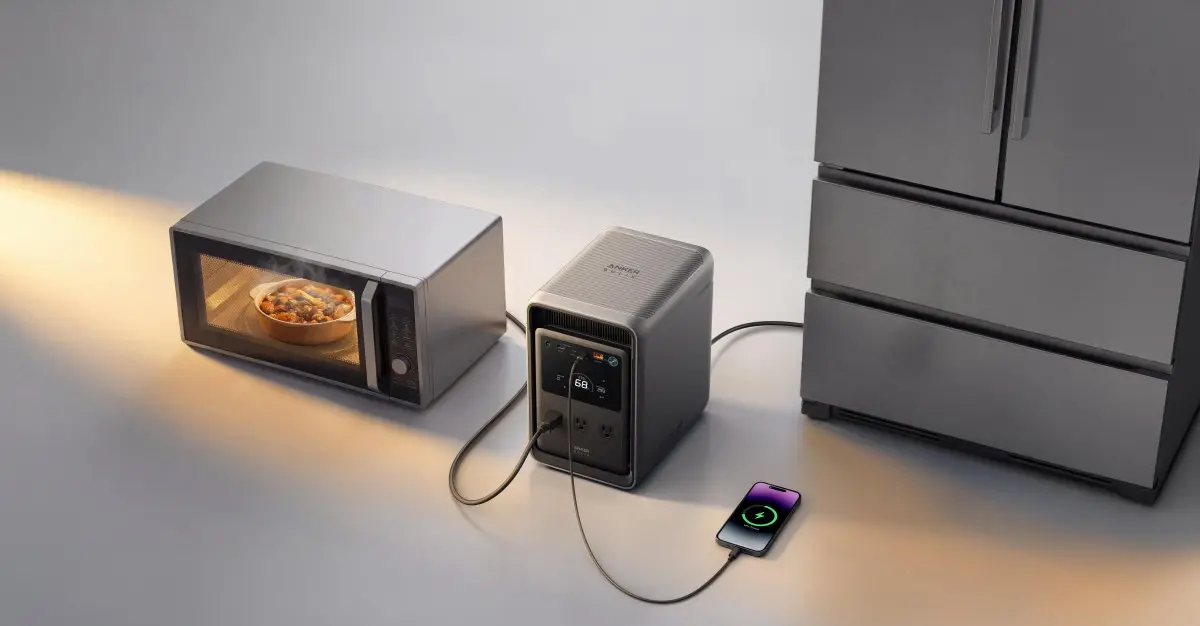
Anker addresses critical flaws in portable power stations
Portable power stations have become essential for outdoor enthusiasts, remote workers, and homeowners preparing for outages. But two persistent issues have plagued the industry: idle power consumption that silently drains batteries, and the large physical footprint needed to store meaningful energy. Anker claims to have solved both with its new Solix S2000, a 2kWh unit that draws only 6W when idle and packs its capacity into a remarkably small chassis.
Idle power draw: a silent killer
Most power stations in the 2kWh range, such as those from EcoFlow, Bluetti, and Jackery, use inverters rated at 2400W or higher. These inverters typically consume 30W or more just by being on—even when no device is plugged in. At that rate, a fully charged battery can be depleted in just a few days if the AC output is accidentally left on. Anker's Solix S2000 uses a 1500W inverter paired with its proprietary “OptiSave” technology, cutting standby draw to approximately 6W. This means the battery can sit idle for nearly two weeks before running flat, dramatically reducing the risk of finding a dead power station when needed.
The lower inverter wattage might seem limiting, but 1500W is sufficient for most household appliances: refrigerators, CPAP machines, coffee makers, water boilers, and small induction cooktops. The unit can also surge to 3000W for brief periods, handling high-draw devices like hair dryers. For most users, this trade-off is well worth the gain in standby efficiency.
Size matters: high energy density
Another common complaint about 2kWh power stations is their bulk. Many competing models measure over 400mm in one dimension and weigh 40 pounds or more. The Solix S2000, by contrast, is only 208 x 282 x 323mm, giving it an energy density of about 106Wh/L. That easily beats the EcoFlow Delta 2 Max, Bluetti AC200L, and Jackery 2000 Plus. For vanlifers and those with limited storage space, this compact design is a significant advantage.
The unit weighs 35.7 pounds (16.2kg), which is manageable for a two-hand carry but still substantial. Anker thoughtfully placed AC outlets on both the front and back panels, so users don't have to rotate the heavy unit to access ports. Inputs include two USB-C (100W max), one USB-A, and a 400W solar input. The battery is built with LFP (lithium iron phosphate) cells, which offer longer cycle life and better safety than traditional NMC batteries, making them ideal for frequent use.
Pricing and availability
Anker is targeting aggressive pricing to capture early adopters. The Solix S2000 is available for preorder at $599 before June 1st, after which the price will rise to between $679.99 and $1,199.99 depending on coupons and retailer promotions. At the $599 price point, it works out to just $0.29 per watt-hour, which is remarkably low for a feature-rich, high-density unit. EU pricing and shipping dates are expected later.
Early reviews of the US model have been positive, with testers confirming the low idle draw and compact form factor. The unit is suitable for a wide range of applications: powering a fridge/freezer during outages for over a day, running networking equipment during brief blackouts, or providing off-grid energy in a camper van.
Background on power station evolution
Portable power stations emerged as a cleaner alternative to gas generators, especially for indoor use. The first mainstream models used lead-acid batteries and offered only a few hundred watt-hours. Today, lithium-ion technology has enabled 2kWh or more in a carryable form. However, as capacity increased, so did inverter size and idle draw. Manufacturers focused on peak output rather than standby efficiency, assuming users would turn units off when not in use. In practice, many forget to turn off AC output, leading to frustration.
Anker's approach with the Solix S2000 represents a shift toward practical usability. By accepting a lower continuous output (1500W), they achieved better energy efficiency and smaller size. This could pressure other brands to optimize their idle consumption and shrink their enclosures, benefiting all consumers.
Comparison with competitors
EcoFlow's Delta 2 Max, for example, offers 2400W continuous output and 2048Wh capacity, but its idle draw is around 30W. Its dimensions are 400 x 210 x 266mm with a weight of 27.5kg (60.6 lbs). Bluetti's AC200L provides 2400W output and 2048Wh, with dimensions 420 x 280 x 386mm and weight 27.5kg. Jackery's 2000 Plus is even larger. While these units can power more demanding appliances simultaneously, they sacrifice portability and standby life.
Anker's Solix S2000 also uses LFP batteries, which typically last 3,000 to 5,000 cycles, compared to 500 to 1,000 cycles for NMC. This makes it a more durable investment for daily use, especially in off-grid setups or as home backup where the unit may cycle frequently.
The solar input of 400W is modest—some competitors offer 800W or more—but for most users, 400W is sufficient to replenish the battery in a day of good sunlight. Anker may release expansion batteries or solar panels in the future to complement the system.
Practical use cases
For vanlifers, space is at a premium. The compact size of the Solix S2000 allows it to slide under a bed or fit in a narrow cabinet. Its low idle draw means it can remain connected to a solar panel and always ready, without draining the battery overnight. For job sites, workers can power tools and chargers without worrying about the unit dying unexpectedly. For home backup, it can keep essential devices running during short outages without needing to be fully turned off between uses.
The 1500W inverter can handle a typical refrigerator (200W startup, 100W running), a CPAP machine (30-60W), and a few lights and phone chargers simultaneously. Surge capacity of 3000W can briefly start a small microwave or hair dryer, though continuous use of such high-draw appliances may require a larger unit.
Anker has also included a comprehensive display and app connectivity (via Bluetooth and Wi-Fi) for monitoring battery level, input/output power, and estimated runtime. Users can set charging schedules and receive alerts if the unit is left on AC output for extended periods.
Market impact and future outlook
The Solix S2000 arrives at a time when the power station market is saturated with similar specs. Anker's differentiation through idle power and size could carve out a loyal niche. The low introductory price may also attract customers who previously considered only cheaper, lower-capacity units. If the product lives up to its claims, it could set a new standard for what consumers expect from a 2kWh power station.
Competitors will likely respond with their own optimizations, either by reducing inverter wattage or by implementing better standby management. This is a positive development for the industry, as it forces innovation beyond just increasing capacity and output. The real-world usability improvements—like not having to worry about a dead battery after a weekend away—are exactly what customers need.
Anker's strategy of partnering with established battery suppliers and leveraging its experience in consumer electronics gives it an edge in reliability and design. The Solix S2000 is not just a me-too product; it addresses real pain points that reviews have highlighted for years. Early adopters who preorder by June 1st will get a significant discount, making it a compelling entry point into high-capacity portable power.
Source: The Verge News