

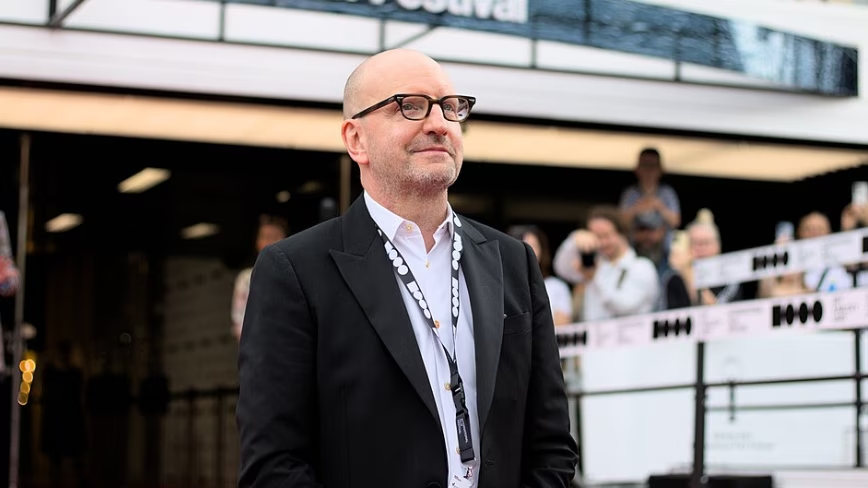
Steven Soderbergh’s “John Lennon: The Last Interview” debuted at the 79th Cannes Film Festival, sparking immediate debate — not about Lennon’s words, but about how those words were visualized. The 97-minute documentary is built around a never-before-released two-hour-and-45-minute radio interview that John Lennon and Yoko Ono gave to a San Francisco KFRC radio crew on December 8, 1980, just hours before Lennon was shot and killed outside the Dakota Apartments. Soderbergh chose to illustrate approximately 10% of the film’s visuals using Meta AI generative software, a decision that has drawn both ire and intrigue.
The AI Controversy
Critics at Cannes overwhelmingly criticized the AI sections, describing them as abstract, surreal, and out of place. The sequences include circles of light, a black rose morphing into choreographic patterns, and paint colors mixing in split screen alongside images of lovers caressing. Soderbergh deliberately avoided deepfakes of Lennon, instead using AI to create imagery for passages where conversation turns philosophical and no archival footage exists. To cover the rest of the film, he assembled more than 1,000 photographs and video clips, editing them to the rhythm of the conversation in what reviewers have called a hyperkinetic photo album.
Soderbergh, known for his innovative and often provocative filmmaking, was candid about the backlash. “I knew what was coming,” he told the Associated Press in Cannes. “You don’t say yes to Meta offering you these tools and offering to finish the film and not know you’re going to come in for some heat. That was part of the deal.” His framework for when AI is justified in filmmaking is simple: “It has to be necessary. Is it the only way to accomplish what I want to see? Is it truly the best way to do it?” He argued that the surreal sequences would have been prohibitively expensive using conventional visual effects, and that the AI tools allowed him to iterate quickly on imagery he struggled to articulate verbally. “I wasn’t very articulate to the people I was working with,” he said. “It was hard to describe the things I wanted to see. The good part about this technology was at least the ability to have something in front of me quickly that I could respond to.”
Transparency Over Permission
The broader argument Soderbergh is making is about transparency, not permission. “In the world outside of the creative context, we’re not aware of the extent that this is being used and used to manipulate us,” he said. “We don’t know because they’re not telling. We find out after, by accident, by some whistle blower. I’m like my own whistle blower.” This position is deliberately provocative: the problem, Soderbergh argues, is not that he used AI, but that he told people he used AI, while countless others are using AI without disclosure.
That argument aligns with data published by Canva in its State of Marketing and AI Report, which found that 97% of marketing leaders now use AI daily, while 78% of consumers still prefer human-made creative work and 87% say the best advertising requires a human touch. Mentions of “AI slop” have increased ninefold. The gap between how widely AI is being used and how willing creators are to admit it is the structural dishonesty Soderbergh is highlighting.
His position on AI’s threat to filmmaking jobs is more measured than most industry voices. “I think most jobs that matter when you’re making a movie cannot be performed by this tech and never will be performed by this tech,” he said. “As it becomes possible for anybody to create something that meets a certain standard of technical perfection, then imperfection becomes more valuable and more interesting.” This formulation inverts the usual anxiety: rather than AI raising the floor and eliminating human work, Soderbergh suggests it will make distinctively human imperfection the scarce and therefore valuable commodity.
Industry Context and Ethical Boundaries
The film industry has been cautiously integrating AI tools for several years. Flawless AI’s DeepEditor, which digitally alters video to synchronize actors’ lip movements with dubbed audio tracks, has been deployed in mainstream productions since 2022, with consent managed through its Artistic Rights Treasury platform. The SAG-AFTRA strike of 2023 established that any meaningful digital alterations to performances require explicit actor consent. Soderbergh’s use case is different: he is not altering existing performances but generating entirely new visual content to accompany audio that has no corresponding video. This ethical territory is less charted, and the documentary serves as a test case for how filmmakers might navigate it.
Critics largely agree that the documentary itself is powerful regardless of the AI controversy. The Wrap called it a film that “does as much to demystify Lennon and Ono as ‘Get Back’ did to the Beatles.” Variety described the AI sections as the weakest part of an otherwise immersive experience. The conversation, edited by Soderbergh and Nancy Main from 165 minutes to 97, captures Lennon at 40 in a state of unusual clarity, talking about love, parenthood, creativity, and his desire to destroy what he called the “male rock star myth” at a time when nobody else in rock music was interested in doing so.
“What I hope young people who see it get out of it is: This guy told the truth about everything from the jump, right up through the last day of his life,” Soderbergh said. “He was very opinionated but also very thoughtful and all in the aid of: Can we do this better? Can we do a better version of human beings on this planet?”
The copyright and creative integrity questions that AI raises in filmmaking are not resolved by one documentary or one director’s framework. Soderbergh acknowledges this openly. “I don’t know where my line is yet. I’m waiting to see,” he said. “Each creative person is going to have their own prism and be affected by it in different ways. Our inherent desire to have a simple template for how this is to be approached is part of the problem. I don’t think that’s possible.”
The film does not yet have a distributor. It was financed in part by Meta, which provided both the AI tools and funding to complete the project. Whether audiences beyond Cannes will have the chance to judge the AI sequences for themselves, or whether the controversy will overshadow the conversation it was built to preserve, remains to be seen. Soderbergh’s stance — that the real problem is hidden AI use, not his own openness — forces the industry to confront its own duplicity. As the technology becomes more accessible, his documentary may be remembered less for its content than for the uncomfortable questions it raises about honesty in an age of generative tools.