

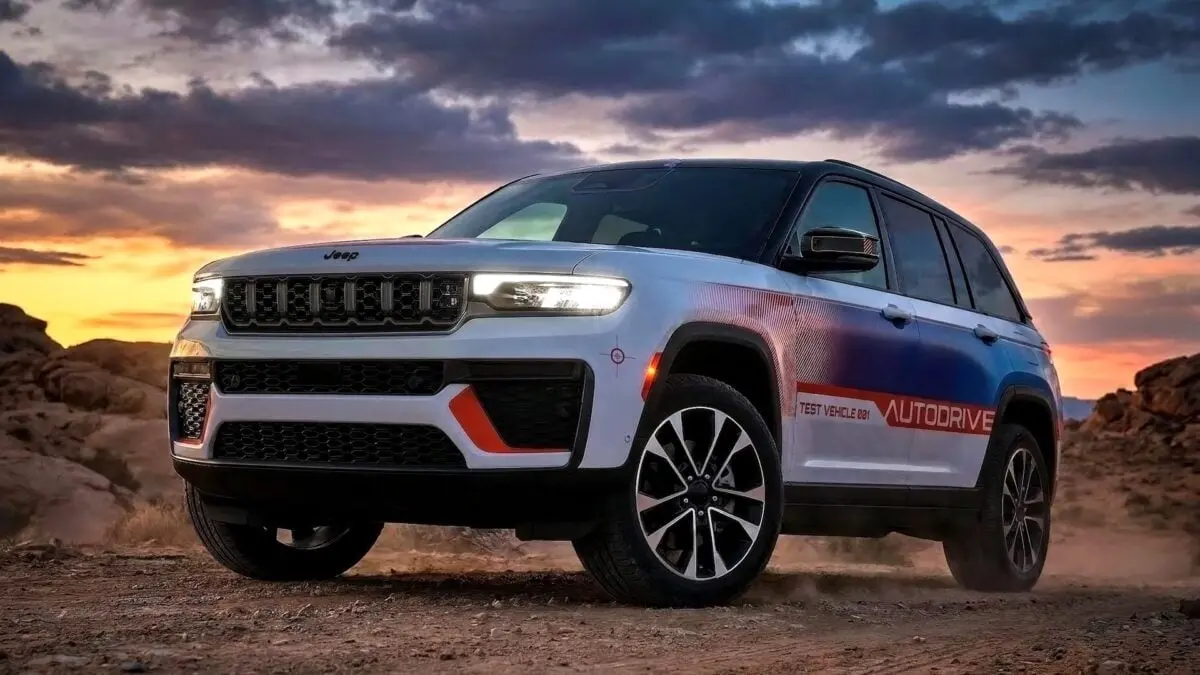
As robotaxi services steadily pop up in cities around the world, self-driving tech in commercial passenger cars has been slow to catch up. Stellantis, the parent company of Jeep, Ram, Dodge, Fiat, and several other car brands, is the latest automaker to announce plans to bring more advanced automated driving tech to its vehicles.
The company announced Thursday a new strategic technology partnership with U.K.-based startup Wayve. The partnership aims to integrate Wayve’s AI Driver system into Stellantis’ STLA AutoDrive platform. That could eventually equip some Stellantis vehicles with hands-free, supervised driving tech that works on both city streets and highways, similar to systems already available on Tesla and Rivian vehicles. Stellantis and Wayve are describing this first iteration as a Level 2++ system, meaning drivers would still need to pay attention to the road and supervise the vehicle as it drives.
The first vehicle integration is planned for North America in 2028. Stellantis says the platform can support more advanced automated driving features down the road as regulations and customer expectations evolve. “This agreement marks an important next step for Wayve and Stellantis in scaling our technology together,” said Alex Kendall, co-founder and CEO of Wayve, in a press release. “Our teams have already demonstrated how quickly the Wayve AI Driver can be integrated across Stellantis’ vehicle platforms, bringing up a prototype in less than 2 months.”
While there is no word yet on which specific brands or models would get the tech first, Wayve developed a prototype with Stellantis in just a few weeks on the company’s Jeep Cherokee platform. This rapid integration demonstrates the flexibility of Wayve’s approach, which relies on cameras and machine learning rather than the high-definition maps used by many competitors. The company’s software is designed to be vehicle-agnostic, meaning it can be adapted to work on everything from passenger cars to delivery vans.
Background on Wayve: A Different Approach to Autonomy
Founded in 2017 in London, Wayve has taken a unique path in the autonomous driving industry. While many companies like Waymo and Cruise rely on detailed 3D maps, expensive lidar sensors, and extensive geofencing, Wayve’s system learns from real-world driving data using deep neural networks. This “end-to-end” approach allows the software to generalize to new roads and conditions without the need for constant map updates. The company believes this will make its technology cheaper to deploy and faster to scale across different vehicle types.
Wayve’s funding history reflects the industry’s confidence in its approach. Earlier in 2026, the startup announced it had closed a $1.2 billion Series D investment round with a range of investors, including SoftBank, Microsoft, Nvidia, and Uber. Just last month, Advanced Micro Devices, Arm, and Qualcomm Ventures announced a separate $60 million investment in the company. Uber’s investment will specifically support Wayve-powered robotaxis on the Uber platform, with the first service planned for London in 2026 and expansion to multiple markets afterward.
Stellantis’ Strategic Move in the Autonomous Driving Race
For Stellantis, the partnership is a way to catch up with rivals like Tesla, General Motors (with its Super Cruise system), and Ford (BlueCruise) that already offer hands-free driving on highways. The company’s STLA AutoDrive platform was developed in-house but has lacked the advanced features now expected by consumers. By integrating Wayve’s AI, Stellantis can offer a system that works on both highways and city streets, a capability that even Tesla’s Full Self-Driving (Supervised) is still refining.
The Level 2++ designation is significant. It implies that the vehicle can handle steering, acceleration, and braking in most situations, but the driver must remain engaged and ready to take over at any moment. This is the same category as Tesla’s Full Self-Driving (Supervised) and Rivian’s Driver+ system. Stellantis and Wayve are positioning their system as a stepping stone toward full autonomy, but they acknowledge that regulatory and safety hurdles remain.
Stellantis’ decision to partner with an external startup rather than develop the technology entirely in-house mirrors a industry trend. Automakers are realizing that developing safe and scalable autonomous driving systems requires enormous investment and expertise. By leveraging Wayve’s proven software, Stellantis can accelerate its timeline and reduce risk.
Comparison with Other Automaker Partnerships
Wayve is not exclusive to Stellantis. In December 2025, Nissan announced it would integrate Wayve’s technology into a broad range of its cars starting in 2027. This multi-automaker approach is part of Wayve’s business model, which aims to become the “operating system” for autonomous driving across the industry. The company’s investors include major automotive and tech players, which gives it both funding and credibility.
Other automakers have taken different routes. Toyota has invested in Waymo and also works with its own research division. Volkswagen has partnered with Mobileye. Hyundai owns a stake in Motional. But the Wayve model—providing a software-only solution that can be retrofitted or integrated into existing platforms—could be more flexible and cost-effective. The fact that Wayve’s system was integrated into a Jeep Cherokee in under two months demonstrates this agility.
Technical Details and Challenges
Wayve’s AI Driver uses cameras only, not lidar or radar, which some experts consider a potential limitation. However, the company argues that its deep learning models can achieve comparable safety levels by learning from vast amounts of driving data. The system processes visual information in real time and makes driving decisions based on patterns learned from human driving. This “learned driving” approach is controversial; some safety advocates worry about the “black box” nature of neural networks and their ability to handle corner cases.
Wayve has addressed this by conducting extensive testing on public roads in the UK and Europe. The company also publishes safety reports and works with regulators to ensure compliance. For the Stellantis partnership, the system will undergo validation and certification for North American roads, which may require additional training on local driving behaviors and infrastructure.
Another challenge is the transition from Level 2++ to higher levels of autonomy. Stellantis says the platform can support more advanced features “as regulations and customer expectations evolve,” but no timeline has been given for Level 4 or Level 5 autonomy. The industry has learned from past overpromises, so both companies are being cautious about future capabilities.
Market Implications and Consumer Impact
For Jeep, Ram, and Dodge owners, the new system could mean reduced fatigue on long highway drives and more confidence in urban traffic. Hands-free driving is increasingly seen as a desirable feature, as evidenced by Tesla’s loyal following. Stellantis has not announced pricing or which trim levels will include the option, but such systems are typically offered as optional packages or subscription services. Industry analysts expect the technology to appear first on higher-end models before trickling down to more affordable vehicles.
The partnership also positions Stellantis to compete in the commercial vehicle space. Wayve’s vehicle-agnostic software could be adapted for delivery vans and trucks, which Stellantis produces under brands like Ram and Fiat Professional. Last-mile delivery autonomy is a growing market, and Stellantis could leverage Wayve’s technology to offer fleet customers cost savings and efficiency improvements.
Competing robotaxi services like Waymo and Cruise have focused on purpose-built vehicles, but Wayve’s approach allows any vehicle with the right sensors to become self-driving. This could accelerate the deployment of autonomous driving across the entire vehicle fleet, rather than limiting it to a small number of specially designed taxis.
Overall, the Stellantis-Wayve partnership is a significant development in the autonomous driving landscape. It brings together a major global automaker with a nimble AI startup, blending mass production capability with cutting-edge software. While the first integration is not expected until 2028, the rapid prototyping phase suggests that the technology is maturing quickly. If successful, Jeep, Ram, and Dodge vehicles could soon offer driving assistance that rivals or exceeds what is available today from leaders like Tesla. The next few years will be critical as the industry moves toward the next generation of automated driving.
Source: Gizmodo News