

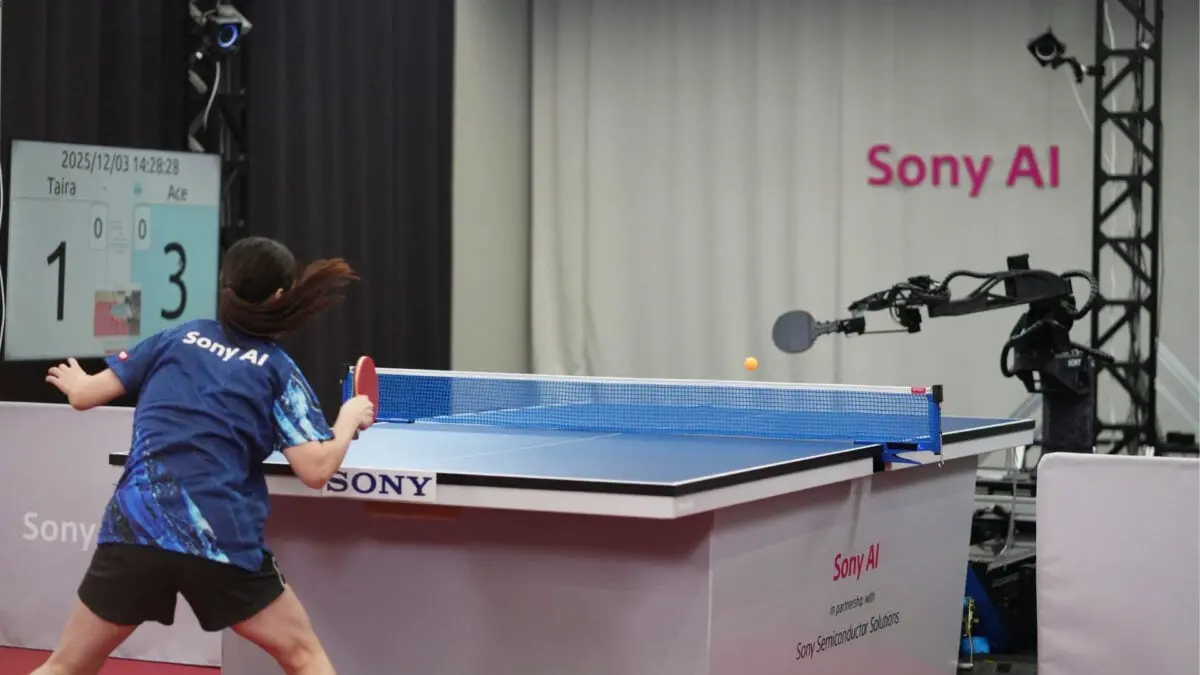
Table tennis, a sport demanding lightning-fast reflexes, precise spin control, and split-second decision-making, has now faced a new kind of opponent: an autonomous robot developed by Sony’s AI division. Dubbed Ace, this robotic system has demonstrated the ability to compete with and even defeat elite human players, marking a significant milestone in the intersection of artificial intelligence and physical robotics.
The research, which was published in the journal Nature, details how Ace consistently outperformed players with over a decade of experience and rigorous training schedules. The robot did not merely mimic human actions but employed a sophisticated AI system capable of real-time perception, strategy adaptation, and high-precision motor control. According to the lead author, Peter Dürr, this work goes beyond a novelty act: it serves as a proof of concept for how AI can operate safely and effectively in the physical world, where perception, control, and agility must come together under the constraints of noisy sensors and adversarial human behavior.
The Rise of Ace
The development of Ace is the result of years of research at Sony AI, focusing on the challenges of real-world interaction. Unlike simulated environments where AI can rely on perfect information, physical table tennis demands that the robot estimate ball trajectories, spin, and speed from imperfect visual data while simultaneously planning its own movements. Ace is equipped with a high-speed camera system, advanced force sensors in its paddle, and a robotic arm capable of rapid, precise motion. The AI software integrates reinforcement learning and model-based control to adjust its play style in real time.
Previous attempts at table tennis robots date back to the 1980s, but they struggled with consistency and the ability to handle high-speed, high-spin shots. Ace overcomes these limitations through a combination of hardware and software innovations. The robot can serve with spin, execute deceptive returns, and even target the edges of the table—a tactic that professional players use to gain an advantage. The AI continuously updates its internal model of the opponent’s strategy, learning patterns during the match to increase its chances of winning.
Technical Challenges and Innovations
One of the greatest hurdles in building a robot capable of competitive table tennis is the sheer speed of the sport. A professional serve can exceed 100 kilometers per hour, with spin rates of over 50 revolutions per second. The ball’s trajectory changes abruptly after bouncing on the table, and the robot must adjust its swing in milliseconds. Ace’s visual system tracks the ball at high frame rates, while its control algorithm predicts the ball’s future position accounting for spin and air resistance.
The robot’s movements are generated by a lightweight, high-torque robotic arm that can accelerate and decelerate rapidly without overshooting. The paddle is equipped with a piezoelectric sensor that measures the impact force and spin, allowing the AI to estimate the opponent’s shot characteristics. This sensor fusion approach is key to Ace’s reliability. The researchers also trained the AI using simulated matches against virtual opponents, then fine-tuned it against human players in a process similar to how human athletes practice.
Another innovation is the use of a hierarchical control system. At the top level, a strategic planner decides which type of shot to execute (e.g., a topspin drive, a backspin chop, or a placement shot). At the lower level, a motion controller converts the desired shot into precise joint angles and velocities. This separation allows the AI to adapt quickly to different opponents without needing to relearn motor skills from scratch.
Performance Against Humans
The study’s official matches were conducted under the rules of the International Table Tennis Federation (ITTF), with licensed umpires overseeing the games. In the first set of matches in April 2025, Ace faced five elite players—defined as individuals with at least 10 years of experience training 20 hours per week on average. The robot won three of these five matches, demonstrating a clear advantage over highly skilled amateurs. It also faced two professional players from Japan’s professional league: Minami Ando and Kakeru Sone. While Ace managed to win one game against each pro, it ultimately lost both full matches, indicating that top-level humans still hold an edge in consistency and strategic depth.
However, Ace improved rapidly. In subsequent matches in December 2025, the robot won one of two matches against professionals. Then in March 2026, it achieved a significant breakthrough: it defeated Miyuu Kihara, who at the time was ranked inside the top 25 in the World Table Tennis rankings for women’s singles. According to Dürr, Ace’s improvement stemmed from its ability to execute faster, more aggressive shots closer to the edge of the table—a tactic that even many professional players struggle to consistently employ.
Broader Implications for Robotics and AI
The success of Ace extends beyond table tennis. The underlying technologies—real-time perception under uncertainty, adaptive control, and human-robot interaction in dynamic environments—have potential applications in numerous fields. In manufacturing, robots that can react quickly to unexpected changes could work alongside humans more safely. In healthcare, similar systems could assist in delicate procedures requiring fast, precise movements. In entertainment, Ace shows how AI can create engaging physical opponents for human players.
Moreover, the research addresses fundamental questions about how AI should be designed to operate in the physical world. Unlike digital games where all rules are known, real-world tasks involve unpredictable variation: changes in lighting, ball wear, or subtle differences in opponent behavior. Ace’s success suggests that a combination of model-based reasoning and learning from experience can handle these challenges. The robot’s ability to play under official rules also sets a new benchmark for evaluating physical AI performance.
The Sony team is continuing to refine Ace, hoping to push its capabilities further. While the robot may not soon dominate professional table tennis, it has already proven that a machine can compete at a level once thought impassable. The lessons learned from Ace will likely inform the design of future robots that must interact with humans in fast, safety-critical environments—from autonomous vehicles to surgical assistants. For now, Ace stands as a remarkable example of how far robotics and AI have come, and how they might continue to blur the line between human and machine performance.
Source: Gizmodo News