

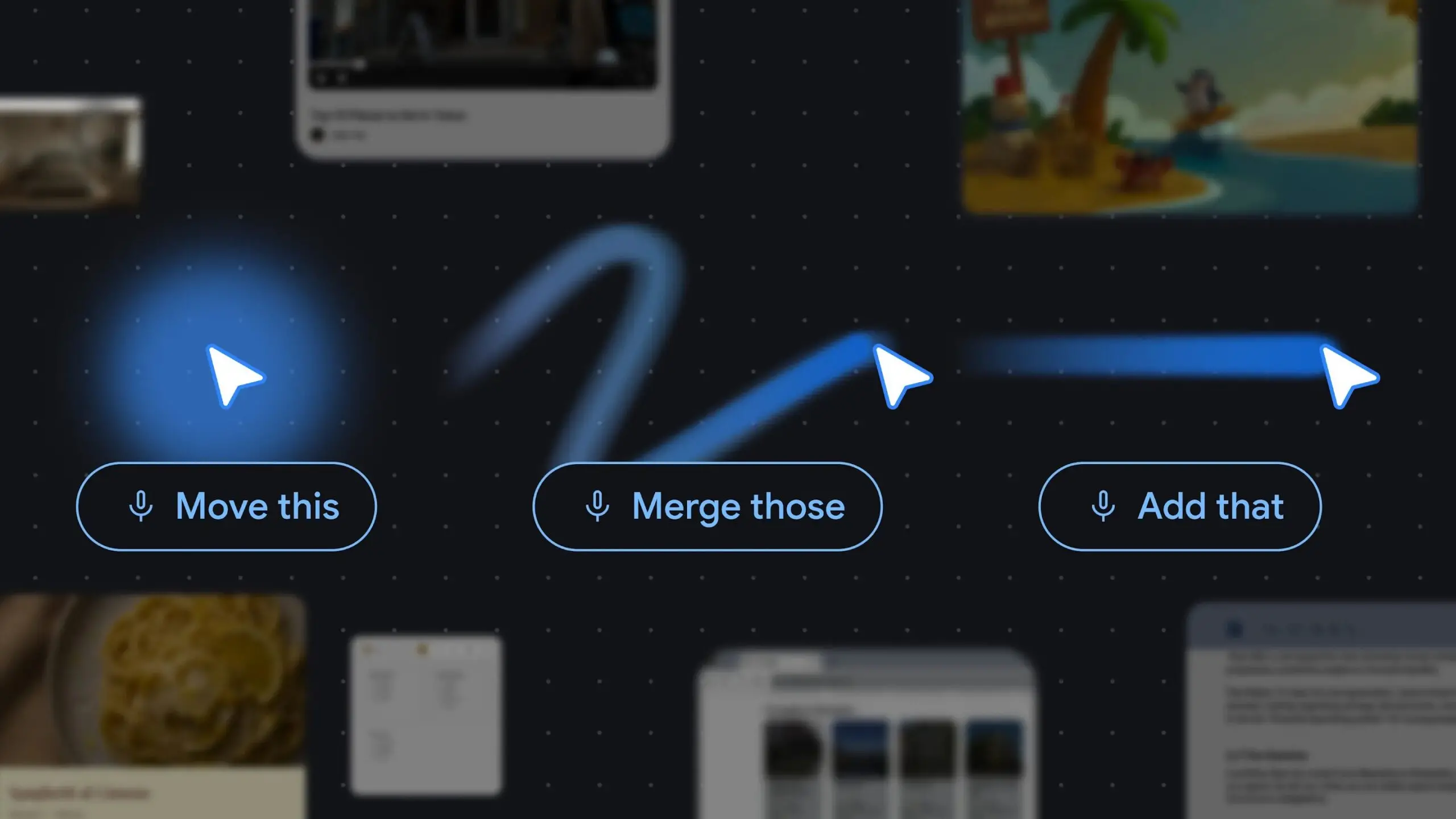
Google's ambitious vision for an AI-powered cursor, known as Magic Pointer, is no longer confined to the recently announced Googlebook laptops. The company has now confirmed that the same intelligent pointer experience is rolling out to Gemini in Chrome, bringing contextual AI assistance to millions of desktop users worldwide.
In a detailed blog post, researchers from Google DeepMind outlined the core philosophy behind Magic Pointer: to fundamentally rethink the mouse pointer, which they note has "barely evolved in more than half a century." The goal is to transform the static cursor into an active, context-aware assistant that users can rely on for everyday tasks without breaking their workflow.
How Magic Pointer Works
Instead of copying text into Gemini or crafting lengthy prompts, Chrome users can now simply point at any element on a webpage—a paragraph, an image, a code block, or a product listing—and ask for help. The AI system, powered by Google's Gemini large language model, understands both what the cursor is pointing at and what the user intends to do with it. DeepMind describes this as turning "pixels into actionable entities," where the AI can recognize objects, dates, places, and other content directly from what's on the screen.
For example, a user could point at several products on a comparison shopping site and ask Gemini to compare them. Alternatively, pointing at an empty corner in a living room photo and saying "visualize a new couch here" would trigger the AI to generate a realistic overlay. These interactions feel more human and conversational, relying on simple requests like "Fix this," "Move that here," or "What does this mean?" rather than verbose typed queries.
The Evolution of the Pointer
The humble mouse cursor has been a staple of personal computing since the 1960s, when Douglas Engelbart first demonstrated the device. Over the decades, its shape and behavior have changed little beyond cosmetic tweaks and the addition of spinning wheels or touch sensors. Google DeepMind argues that the current pointer is a one-way communication channel—users click and drag, but the cursor never "understands" the content it traverses. Magic Pointer aims to close that loop, making the cursor an active participant in the interaction.
This shift is part of a broader trend in human-computer interaction, where AI systems are moving from being reactive (waiting for commands) to proactive (anticipating needs). Microsoft's Copilot, Apple's planned on-device AI features, and Google's own Gemini have all explored similar territory, but Magic Pointer is unique in leveraging the very act of pointing as a primary input modality.
Technical Implementation and Limitations
Magic Pointer is built on Gemini's multimodal capabilities, allowing it to process text, images, code, and spatial data simultaneously. The Chrome integration leverages the browser's ability to access webpage content while respecting privacy—DeepMind emphasizes that the AI processes information locally where possible and uses anonymized data for model improvements. However, the most computationally intensive tasks, such as image generation for "visualize a new couch," may require cloud processing.
Google has not yet disclosed which regions or user segments are receiving Magic Pointer access first. Early attempts to test the feature directly in Chrome have not yielded results, suggesting a gradual rollout similar to previous Gemini AI features. The company notes that the full Magic Pointer ecosystem, including its hardware-accelerated capabilities on Googlebooks, will unlock more complex experiences, while the Chrome version will focus on everyday tasks like comparison and visualization.
Use Cases Beyond Shopping
While the press release highlights e-commerce scenarios, the potential applications are vast. In a research context, a user could point at a dense paragraph on an academic paper and say "summarize this." Developers can point at a buggy line of code and ask "what's the error here?" Travelers could hover over a handwritten note in a scanned document and request translation or contact addition. The system's ability to understand spatial context—knowing exactly which part of an image or document the user cares about—removes the friction of manually selecting regions or copying snippets.
DeepMind also envisions using Magic Pointer to interact with video content. For instance, pointing at a restaurant that appears in a travel vlog could trigger a sidebar with reviews, menu, and booking links. This transforms passive viewing into an interactive experience, effectively making any on-screen element a potential launchpad for AI assistance.
Competitive Landscape and Industry Reactions
Google's move comes as competitors race to integrate AI into core browsing experiences. Microsoft's Edge recently added Copilot integration that can summarize web pages and answer questions, but it relies on chat-based interactions rather than pointer-driven fluidity. Apple is rumored to be working on contextual AI for Safari, though details remain scarce. Magic Pointer's advantage lies in its minimal learning curve—users already instinctively point at things; now the system can respond.
Privacy advocates have raised questions about what data the cursor's AI collects, particularly if it scans all on-screen content. Google has promised transparency and control, with options to disable Magic Pointer per site or globally. The company also stresses that the feature enhances accessibility, enabling users with motor impairments to interact with content using simple pointing gestures combined with voice commands.
As the digital landscape becomes increasingly saturated with AI agents, Magic Pointer represents a bet on retaining the mouse and keyboard as primary input devices, rather than shifting entirely to voice or text-based assistants. By augmenting an existing universal gesture—pointing—Google hopes to make AI assistance feel less like a separate tool and more like an extension of the user's own intent.
Source: Android Authority News